Built from 15,000+ critical incidents across HazMat, fire, and emergency command. The Velocity Mandate is now deployed in the boardroom, the command center, and the field — backed by Aegis-V, sovereign AI for crisis detection.
Stone on stage
Experienced pilots. A sound aircraft. Good training. They missed the one action that would have stopped the aircraft — not because they didn't know it existed, but because latency stole the window.
The gap between knowing and acting has a name: decision latency. After 30 years and 15,000 critical incidents, it is the single most predictable cause of preventable loss — and the one number most organizations have never measured.
Your plan can be 300 pages long. Physics doesn't read it.
field photo
Command Velocity equals Accuracy divided by Latency. The only published methodology that makes crisis decision-speed a measurable, improvable system — so you can score it, and close the gap before an incident does.
How fast your organization moves from threat detection to correct action.
Getting the decision right. Speed without accuracy is just a faster way to fail.
The total time that elapses from detection to execution. The variable you attack.
Every principle in the Velocity Mandate is reverse-engineered from documented disasters where response speed lost the race against physics.
A flawed algorithm executed perfectly. Humans needed 15 minutes to find the kill switch. Bankrupt before lunch.
Algorithms traded faster than humans could perceive. By the time anyone understood, the damage was total.
Water leak. Rising pressure. Eye irritation. Every weak signal was seen, reported, and waited on — until it screamed.
Almost six hours of recognition, assessment, and decision latency. By the time action came, physics had already won.
Before we ever discuss an engagement, the Velocity Diagnostic shows you that number. Once you see it, the rest is arithmetic.
| Sector | The latency problem | Annual cost of latency |
|---|---|---|
| Healthcare Systems | Delayed code response, slow sepsis detection | $2M–$8M in preventable events |
| Industrial / HazMat | Slow HazMat decision, equipment failure delay | $500K–$5M per incident |
| Financial Services | Delayed fraud response, market-event latency | $1M–$50M per event |
| Municipal / EM | Slow evacuation, command-structure breakdown | Legal · political · human life |
| Defense / Federal | Mission-critical latency in contested environments | Catastrophic |
Get the V=A/L Latency Audit Tool — the same one-page framework used across 15,000+ incidents to pinpoint exactly where organizations lose time in a crisis. No call required.
If a single slow decision can cost lives, dollars, or the organization itself — this is built for your environment.
Code response, sepsis detection, and sentinel-event prevention — where minutes decide outcomes.
Evacuation calls and command-structure speed when the threat is already moving.
Fraud response, market-event latency, and resilience against computational-speed failures.
Release decisions and equipment-failure response where the chemistry doesn't wait.
Mission-critical latency in contested, high-consequence environments.
When one slow decision under pressure threatens the entire organization.
Each tier is a standalone outcome — and a measured one. Start with a diagnostic; scale to an enterprise system.
No 300-page binder. A measurement, a report, and a roadmap your leadership can act on immediately.
We confirm fit and scope your three most plausible crisis scenarios.
Day 0On-site or virtual. We map latency across the 5 nodes and calculate your V=A/L baseline live, with your leadership team.
The engagementA 12–18 page report: your Detection & Decision Latency, Cascade Risk Score, and prioritized gaps.
Within 72 hrsA week-by-week plan ready to present — and a clear path into the full Velocity Command Program.
OngoingNo competitor can offer a sovereign, airgapped AI platform that continuously monitors for latency failures and generates crisis-detection intelligence. With Aegis-V, you are not buying training — you are deploying an operational system that lives inside your organization permanently.
The gap between what you know and how fast you can act on it. That gap has a name: latency. This talk introduces V=A/L — a field-tested framework that reframes crisis decision-making as a measurable, improvable system.
From keynote stages to studios and podcasts, Stone brings V=A/L to the leaders who carry catastrophic risk: emergency managers, hospital and risk executives, military and government audiences. Available for interviews, podcasts, panels, and on-camera commentary on crisis decision-making and the AI-speed threat era.
Stone in the studio

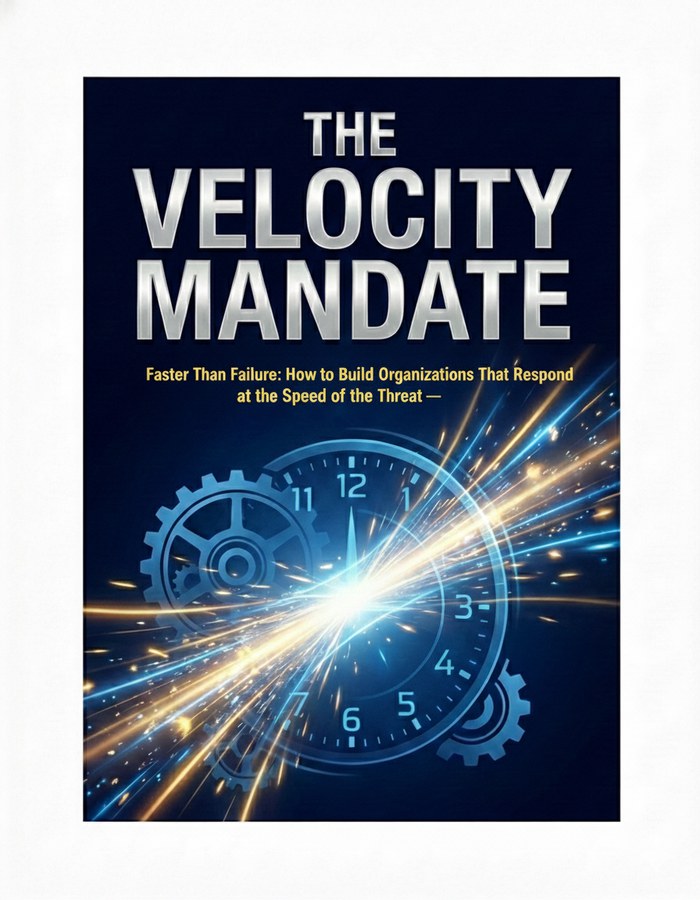
The complete doctrine for crisis velocity — 30 years of frontline command, formalized into V=A/L and a system any organization can deploy. The reference text behind every program, and the authority anchor of the methodology.
“Every crisis is a race between your decision velocity and the physics of disaster. The plan doesn't matter if you're too slow to execute it.”
A complete, implementable system for engineering command velocity — from the physics of failure to muscle memory that survives stress.
Why the clock always wins, the polycrisis reality, and your brain on fire.
Recognition-primed decisions, the tunnel-vision trap, the five latency points.
High-reliability organizations, weak-signal detection, information triage.
The commitment trap, the ethical anchor, and the psychology of panic.
Default response, rapid-cycle deliberate practice, stress exposure simulation.
AI detects threats in milliseconds. Humans bring the judgment AI can't. But the coordination latency between them is where most organizations bleed to death. The Velocity Mandate is how you close that gap.
Documented pre/post V=A/L velocity metrics are included at every tier. If latency does not improve by the agreed target after the core program, additional sessions are delivered at no charge. You succeed when your people decide faster under pressure — that's the offer. In 30 years and 15,000+ incidents, the gaps have always been there. The only question is whether you see them before a crisis does.
Stone — Brian Arradondo
At 18, Brian entered a world where decision velocity meant the difference between someone going home to their family — or not. For nearly two decades he made life-and-death calls in the field as a Fire Captain and first responder in Minneapolis: HazMat, fire, emergency command. Across 15,000+ critical incidents — the Superior Plating chemical release, the I-35W bridge collapse, the Third Precinct — he learned the pattern that kills people: the gap between knowing what to do and doing it under pressure.
He spent the years after deconstructing that gap into a measurable system — V=A/L — and the cognitive framework behind it, Systemic Behavioral Dynamics. Today he formalizes the doctrine in The Velocity Mandate and the Aegis-V platform, and brings it into boardrooms, command centers, and conference stages. Stone doesn't sell hope. He sells proof — a measured number, and the system to improve it.
Grab a time directly, or send a note and we'll follow up. Either way, you'll know within one call whether the Velocity Diagnostic is a fit.